CQRS Pattern Explained: Build High-Performance & Scalable Microservices
Introduction: Why Traditional CRUD Fails at Scale
Most applications start simple:
One database
One model
Same logic for reads and writes
It works… until traffic explodes.
Suddenly:
❌ Read queries slow everything down
❌ Writes lock tables
❌ Complex joins hurt performance
❌ Scaling becomes painful
This is where CQRS Pattern steps in — not as a theory, but as a battle-tested enterprise solution.
What Is CQRS Pattern?
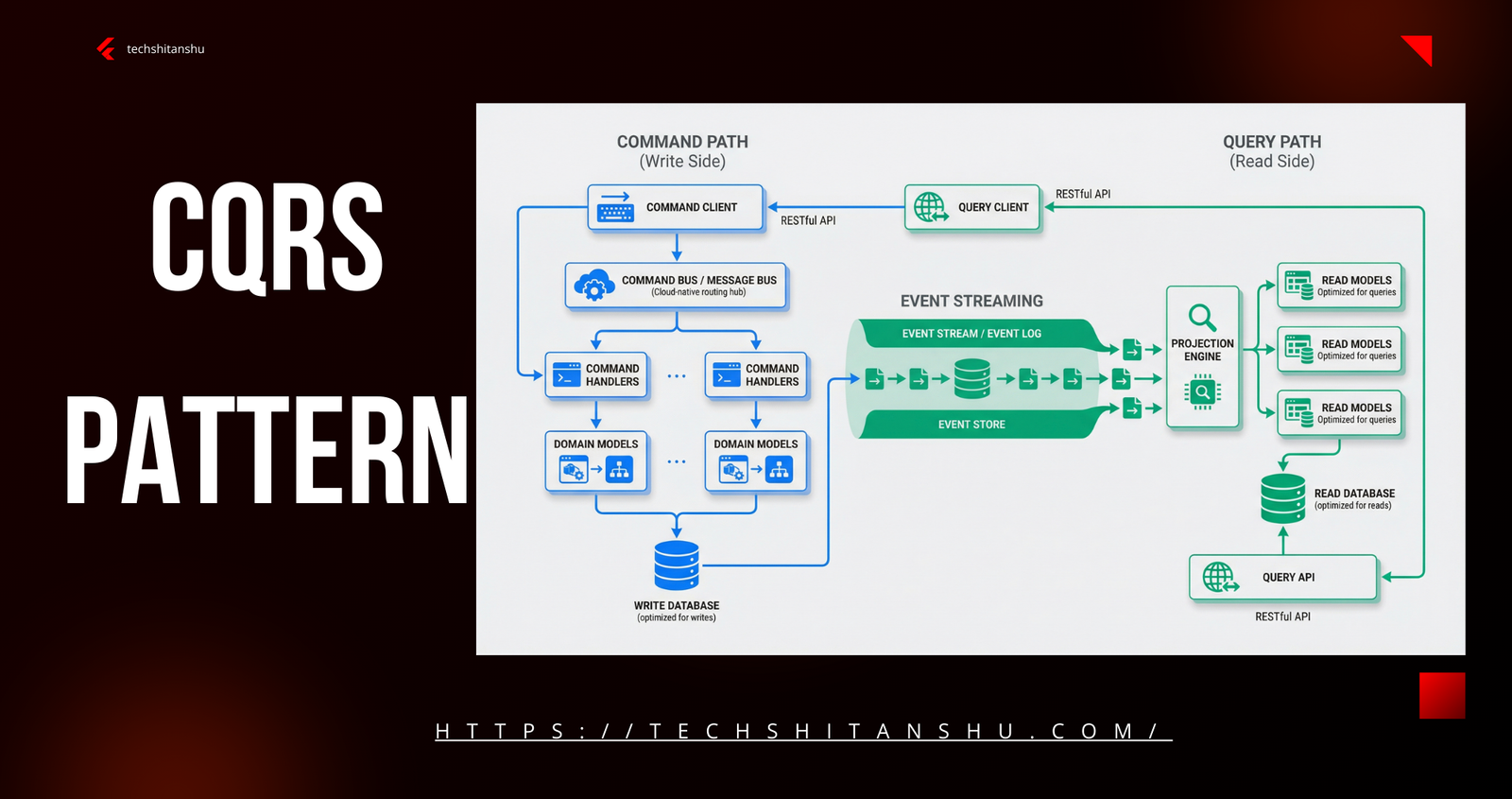
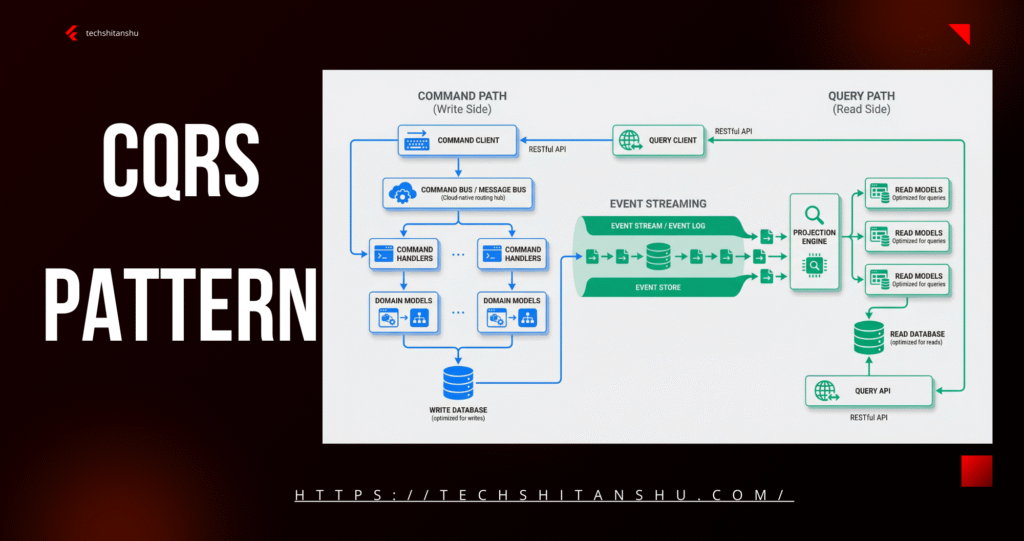
CQRS (Command Query Responsibility Segregation) is a design pattern that separates read operations from write operations.
Core Rule:
Commands change data. Queries read data. They never overlap.
That’s it. Simple idea — massive impact.
CQRS Architecture at a Glance
🔹 Command Side (Write Model)
Handles create/update/delete
Enforces business rules
Uses normalized data
Optimized for consistency
🔹 Query Side (Read Model)
Handles read-only requests
Uses denormalized views
Optimized for speed
Often uses different databases
Why CQRS Is a High-Value Pattern
Enterprises adopt CQRS because it solves real money problems:
✔️ Massive read scalability
✔️ Faster APIs
✔️ Independent scaling of reads/writes
✔️ Clean business logic
✔️ Perfect fit for event-driven systems
This is why CQRS keywords attract high-paying ads in cloud, SaaS, and fintech niches.
Simple Example (Without Buzzwords) Traditional System
User Service → User Table → Same DB for reads & writes
CQRS System
Command API → Write DB → Events → Read DB → Query API
Reads never slow down writes. Writes never break reads.
Real-World Use Case: E-Commerce Platform
Without CQRS
Product updates slow page loads
Order writes block read traffic
Reporting kills performance
With CQRS
| Side | Responsibility |
|---|---|
| Command | Create orders, update inventory |
| Query | Product listing, order history |
| Read DB | Optimized JSON views |
| Write DB | Transaction-safe relational DB |
Result:
🚀 Faster checkout
📈 Better scaling
😌 Happier users
CQRS + Event-Driven Architecture (Best Combo)
CQRS shines brightest when combined with events.
Flow:
Command updates data
Event is published
Read models update asynchronously
Queries hit fast read DB
This enables:
Loose coupling
Event replay
Real-time dashboards
CQRS vs CRUD (Quick Comparison)
| Feature | CRUD | CQRS |
|---|---|---|
| Read performance | Medium | Very high |
| Write complexity | Low | Medium |
| Scalability | Limited | Excellent |
| Business logic | Mixed | Clean |
| Enterprise readiness | Low | High |
Databases in CQRS
One of CQRS’s superpowers: polyglot persistence.
Common Choices
Write DB: PostgreSQL / MySQL
Read DB: Redis / MongoDB / Elasticsearch
Events: Kafka / RabbitMQ
Each database does what it’s best at.
CQRS Without Event Sourcing (Yes, Possible)
Important myth to break:
❌ CQRS ≠ Event Sourcing (always)
You can:
Use CQRS with normal databases
Sync read models via messaging
Keep architecture simpler
Event sourcing is optional — not mandatory.
Challenges You Must Prepare For
⚠️ Eventual Consistency
Reads may lag writes by milliseconds or seconds.
⚠️ More Infrastructure
Extra databases, message brokers, monitoring.
⚠️ Higher Learning Curve
Not beginner-friendly.
CQRS is powerful — but not free.
When You SHOULD Use CQRS
✔️ Read-heavy systems
✔️ High traffic APIs
✔️ Complex business rules
✔️ Large teams
✔️ Cloud-native platforms
When You SHOULD NOT Use CQRS
❌ Small CRUD apps
❌ Simple internal tools
❌ Early MVPs
❌ Teams without DevOps maturity
CQRS + Other Patterns (Enterprise Stack)
CQRS works beautifully with:
Database per Service Pattern
Saga Pattern
Event Sourcing
API Gateway
BFF Pattern
This makes it a cornerstone of modern microservices.
Best Practices (Production Ready)
✔️ Keep commands small and explicit
✔️ Never return data from commands
✔️ Optimize read models aggressively
✔️ Monitor event lag
✔️ Document consistency guarantees
✔️ Secure both read & write APIs
FAQs (Rich Results Ready)
❓ Is CQRS mandatory for microservices?
No, but it’s highly recommended for read-heavy, scalable systems.
❓ Does CQRS always require Event Sourcing?
No. CQRS and Event Sourcing are independent patterns.
❓ Is CQRS expensive?
Initially yes — long-term it reduces performance and scaling costs.
❓ Can CQRS work in monoliths?
Yes. Many systems adopt CQRS before splitting into microservices.
❓ Is eventual consistency risky?
Only if not communicated clearly. Most users never notice.
Final Verdict
CQRS isn’t about complexity — it’s about control.
If your system needs:
Speed
Scale
Clean architecture
Enterprise reliability
Then CQRS Pattern is not overengineering — it’s future-proofing.
“Part of our Microservices Design Patterns Series.”

Leave a Reply