What is Distributed Systems? Complete Beginner Guide (2026)
Introduction: Why Distributed Systems Matter Today
Every time you scroll Instagram, stream Netflix, or shop on Amazon, you are interacting with a distributed system.
Modern applications are no longer built on a single server. Instead, they rely on multiple machines working together seamlessly to deliver speed, reliability, and scalability.
But what exactly is a distributed system?
Why is it the backbone of cloud computing and modern software architecture?
Let’s break it down in the simplest way possible.
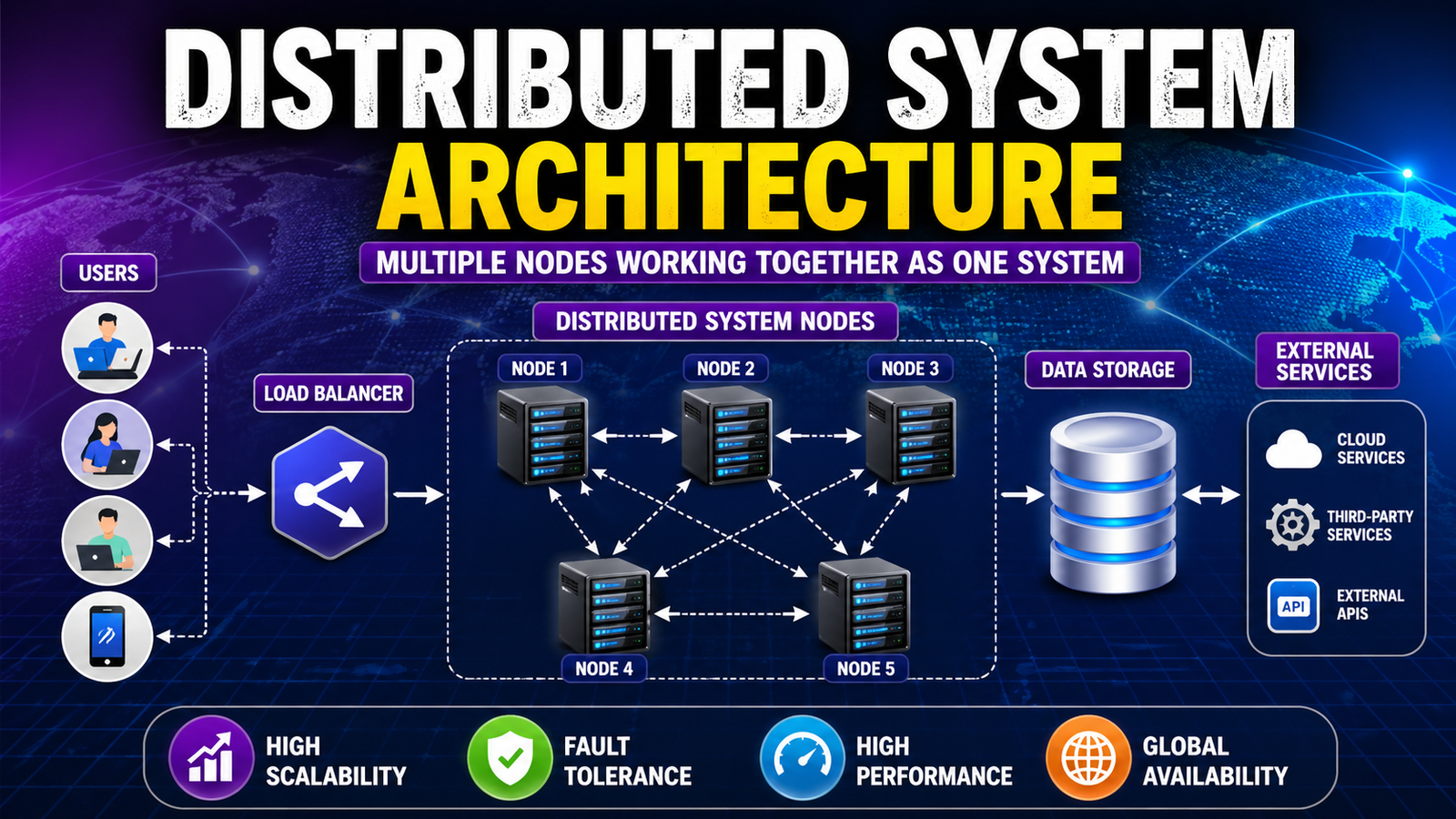
What is a Distributed System?
A Distributed System is a collection of independent computers that work together as a single system to achieve a common goal.
These systems:
- Communicate over a network
- Coordinate actions
- Share resources
Simple Definition:
A distributed system is a system where multiple computers collaborate to appear as one unified system to users.
Real-Life Examples of Distributed Systems
Understanding becomes easier with examples:
1. Social Media Platforms
Apps like Instagram and Facebook use thousands of servers globally to:
- Store user data
- Serve content instantly
- Handle millions of requests per second
2. Streaming Platforms
Netflix distributes its content across global servers so you can stream without buffering.
3. E-commerce Platforms
Amazon uses distributed systems to:
- Manage inventory
- Process payments
- Recommend products
4. Cloud Computing Platforms
Services like AWS, Azure, and Google Cloud are built entirely on distributed systems.
How Distributed Systems Work
At a high level, a distributed system works through:
1. Multiple Nodes (Servers)
Each computer (node) performs a specific task.
2. Communication
Nodes communicate using APIs, message queues, or protocols.
3. Coordination
They synchronize data and operations to act as one system.
4. Fault Handling
If one node fails, others take over.
Key Characteristics of Distributed Systems
🔹 1. Scalability
You can add more servers to handle increased load.
🔹 2. Fault Tolerance
System continues working even if some components fail.
🔹 3. Transparency
Users don’t know multiple systems are involved.
🔹 4. Concurrency
Multiple operations happen simultaneously.
🔹 5. Resource Sharing
Different systems share data and computing power.
Distributed Systems vs Traditional Systems
| Feature | Traditional System | Distributed System |
|---|---|---|
| Architecture | Single machine | Multiple machines |
| Scalability | Limited | Highly scalable |
| Fault Tolerance | Low | High |
| Performance | Moderate | High |
| Complexity | Low | High |
Types of Distributed Systems
1. Client-Server Systems
- Clients request services
- Servers respond
Example: Web applications
2. Peer-to-Peer Systems
- All nodes are equal
- No central server
Example: Torrent networks
3. Cloud-Based Systems
- Built on virtual infrastructure
- Highly scalable
4. Distributed Databases
- Data stored across multiple locations
Core Concepts You Must Understand
1. CAP Theorem
A distributed system can only guarantee two of the following:
- Consistency
- Availability
- Partition Tolerance
2. Consistency Models
- Strong consistency
- Eventual consistency
3. Latency vs Throughput
- Latency = response time
- Throughput = number of requests handled
4. Replication
Data is copied across multiple servers.
5. Partitioning (Sharding)
Data is split across nodes.
Challenges in Distributed Systems
Distributed systems are powerful—but not easy.
Common Challenges:
- Network failures
- Data inconsistency
- Debugging complexity
- Security risks
- Latency issues
Security in Distributed Systems
Security is a high CPC topic and critical in real-world systems.
Key Practices:
- Encryption (TLS/SSL)
- Authentication (OAuth, JWT)
- Zero Trust Architecture
- API Security
Advantages of Distributed Systems
✅ High scalability
✅ Better performance
✅ Fault tolerance
✅ Global availability
✅ Resource efficiency
Disadvantages
❌ Complex to design
❌ Hard to debug
❌ Network dependency
❌ Security challenges
Popular Technologies Used
- Kubernetes
- Docker
- Apache Kafka
- Redis
- Cassandra
Use Cases in 2026
Distributed systems power:
- AI applications
- Real-time analytics
- Blockchain systems
- IoT networks
- Cloud-native apps
Future of Distributed Systems
The future is evolving rapidly with:
- AI-driven architectures
- Edge computing
- Serverless systems
- Quantum computing integration
Real-world examples like Netflix, Amazon, and Google show how distributed systems power modern applications at global scale.
1. Netflix – Global Video Streaming at Scale
When you press “Play” on Netflix, a LOT happens instantly:
What’s happening behind the scenes:
- Your request goes to the nearest server (via CDN)
- A load balancer routes your request
- Content is fetched from a distributed storage system
- Video chunks are streamed from multiple servers simultaneously
Distributed Concepts Used:
- Content Delivery Networks (CDN)
- Load balancing
- Data replication
- Fault tolerance
Why distributed?
If Netflix used a single server:
👉 Millions of users = instant crash
2. Amazon – Massive E-commerce Engine
When you search for a product on Amazon:
What happens:
- Search service fetches results from distributed databases
- Recommendation system suggests products (ML models running separately)
- Inventory system checks stock across warehouses
- Payment service processes transactions
Distributed Concepts Used:
- Microservices architecture
- Distributed databases
- Event-driven systems
- High availability
Key insight:
Each feature = separate service
👉 If recommendations fail, checkout still works
3. WhatsApp – Real-Time Messaging
Sending a message feels instant—but it’s powered by distributed systems.
Flow:
- Message sent to nearest server
- Routed to recipient’s region
- Stored temporarily (if user offline)
- Delivered once user reconnects
Concepts Used:
- Event-driven architecture
- Message queues
- Data replication
- Low-latency communication
Why distributed?
To support billions of messages per day globally
4. Google Search – Lightning-Fast Results
When you search something:
Behind the scenes:
- Query is sent to multiple data centers
- Index is distributed across thousands of machines
- Results are aggregated and ranked
- Best results returned in milliseconds
Concepts Used:
- Distributed indexing
- Parallel processing
- Data partitioning (sharding)
- Load balancing
Fun fact:
Google processes queries using parallel distributed systems in real time
5. Cloud Platforms (AWS, Azure, GCP)
Cloud computing IS distributed systems.
What happens:
- Your app runs on virtual machines across regions
- Storage is replicated across zones
- Auto-scaling spins up new servers when needed
Concepts Used:
- Elastic scalability
- Distributed storage
- Fault isolation
- Multi-region deployment
Why it matters:
Your app never depends on a single server
6. Uber – Real-Time Ride Matching
When you book a ride:
Flow:
- Your location is sent to backend
- Nearby drivers fetched from distributed location services
- Matching algorithm runs in real-time
- Driver + rider connected instantly
Concepts Used:
- Real-time data processing
- Geo-distributed systems
- Event streaming
- Low latency systems
Challenge solved:
Matching millions of users in seconds
7. Online Multiplayer Games (PUBG, Fortnite)
Behind the scenes:
- Game state synced across servers
- Players connected to nearest region
- Events processed in real-time
Concepts Used:
- State synchronization
- Distributed servers
- Latency optimization
Why distributed?
To ensure smooth gameplay globall
8. Banking Systems & UPI Payments
When you send money via UPI:⚙️ Flow:
- Request goes to bank servers
- Payment gateway verifies
- Funds transferred across banks
- Transaction recorded
Concepts Used:
- Distributed transactions
- Strong consistency
- Fault tolerance
- Security layers
Critical requirement:
👉 No data loss = money safety
Key Takeaways
All these systems share common patterns:
They:
- Run on multiple servers
- Scale horizontally
- Handle failures automatically
- Serve global users
Simple Analogy
👉 A distributed system is like a team of workers:
- One cooks
- One serves
- One manages orders
Even if one fails, others keep the system running.
FAQ
What is the main purpose of a distributed system?
To improve scalability, reliability, and performance by using multiple machines.
Is the internet a distributed system?
Yes, it is one of the largest distributed systems in the world.
What is an example of distributed computing?
Cloud platforms like AWS or streaming services like Netflix.
Why are distributed systems complex?
Because multiple machines must coordinate and handle failures.
What skills are needed?
System design
Networking
Cloud computing
Databases

Leave a Reply