Building Generative AI Applications with Spring Boot
Generative AI is no longer limited to Python notebooks or experimental demos. It is rapidly becoming a backend capability—embedded into APIs, services, and enterprise workflows. For Java developers, this shift raises an important question:
How do you build Generative AI applications using Spring Boot in a clean, production-ready way?
This article explains how Java teams design and implement AI-powered backend applications using Spring Boot and Spring AI, focusing on architecture, components, and real-world patterns rather than hype.
Why Generative AI Belongs in the Backend
Most early AI examples focus on frontend chat interfaces. In reality, the most valuable Generative AI use cases live behind the scenes, such as:
AI-powered internal tools
Intelligent search and document Q&A
Automated summaries and reports
Support assistants for operations teams
AI-enhanced business workflows
These use cases require:
Authentication and authorization
Observability and logging
Cost control and rate limiting
Integration with databases and services
This is exactly where Spring Boot excels.
Spring Boot as the Foundation for AI Applications
Spring Boot provides the infrastructure needed to run Generative AI reliably:
Dependency management
Configuration and profiles
REST APIs and messaging
Security and access control
Metrics, tracing, and logging
Instead of treating AI as a standalone experiment, Spring Boot allows AI to become a first-class backend component.
However, interacting directly with LLM APIs from application code quickly becomes messy. This is where Spring AI fits in.
How Spring AI Fits into Spring Boot Applications
Spring AI is a framework that brings Spring-style abstractions to Generative AI. It does not try to hide AI concepts—but it standardizes how Java applications interact with them.
Spring AI provides:
Consistent APIs for chat models and embeddings
Externalized configuration for model providers
Vendor-agnostic abstractions
Integration with Spring Boot’s lifecycle
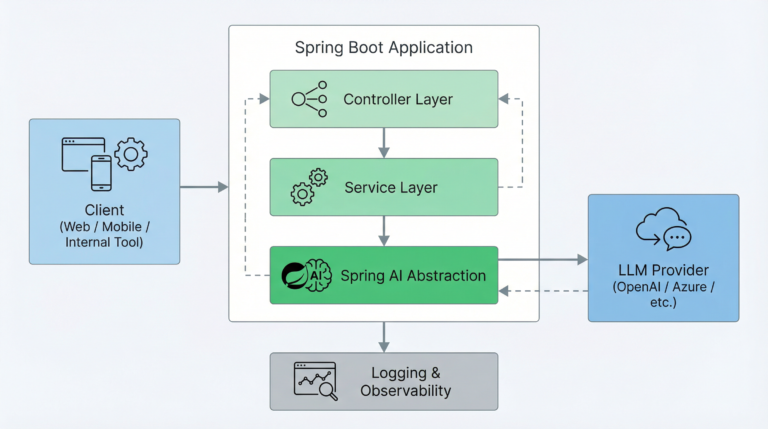
In a Spring Boot application, Spring AI typically sits between:
Your business logic
External LLM and embedding providers
This keeps AI logic clean, testable, and maintainable.
Core Components of a Generative AI Spring Boot Application
1. Chat Models
Chat models are used for text generation, summarization, and reasoning. In Spring AI, chat models are accessed through consistent interfaces regardless of provider.
Use cases include:
Conversational APIs
Text transformations
Classification and decision support
Chat models are usually wrapped inside service classes, not controllers.
2. Prompts and Prompt Templates
Prompts are not static strings in production systems.
In real applications:
Prompts evolve over time
Inputs are dynamically injected
Prompts must be versioned and tested
Spring AI supports structured prompt handling, allowing prompts to be treated as configuration rather than hard-coded text.
3. Embeddings
Embeddings convert text into numerical vectors that capture semantic meaning.
They are essential for:
Semantic search
Document similarity
Retrieval-Augmented Generation (RAG)
In Spring Boot applications, embeddings are usually generated once and stored, not recalculated on every request.
4. Vector Stores
Vector stores allow fast similarity search across embeddings.
Common patterns include:
Indexing documents during ingestion
Query-time similarity search
Passing retrieved context into prompts
Spring AI integrates vector stores into the application flow, making them part of backend architecture rather than ad-hoc utilities.
Typical Architecture of a Spring Boot Generative AI App
A production-ready architecture often looks like this:
REST or Messaging API receives user input
Service layer applies business rules
Embedding or retrieval step fetches relevant context
Prompt construction combines instructions + data
Chat model invocation generates output
Post-processing validates or formats the response
Each step is isolated, testable, and observable.
This approach prevents AI logic from leaking into controllers or UI layers.
Building a Simple AI-Powered Endpoint
A common starting point is a REST endpoint that accepts input and returns AI-generated output.
Best practices include:
Keeping controllers thin
Moving AI calls into service classes
Validating input before invoking models
Logging prompt metadata (not raw data)
This mirrors how Java teams already build maintainable backend services.
Handling Non-Determinism in AI Responses
Unlike traditional APIs, Generative AI responses are non-deterministic.
This introduces challenges such as:
Inconsistent outputs
Unexpected phrasing
Occasional hallucinations
Production systems handle this by:
Constraining prompts
Applying output validation
Adding guardrails and fallbacks
Logging responses for analysis
Spring Boot’s structured logging and exception handling are critical here.
Observability and Cost Control
AI systems introduce new operational concerns:
Latency
Token usage
Cost per request
Spring Boot applications should:
Track response times
Monitor model usage
Apply rate limiting
Cache results when possible
Treat AI calls like expensive downstream services—not like simple utility methods.
Security Considerations
AI endpoints should never be open by default.
Important security practices include:
Authenticating all AI requests
Filtering sensitive data before prompting
Preventing prompt injection
Limiting model access by role
Spring Security integrates naturally with AI endpoints, making this easier to enforce.
Common Mistakes When Building AI with Spring Boot
Many teams struggle because they:
Hard-code prompts in controllers
Skip observability
Treat AI responses as always correct
Ignore vendor lock-in
Prototype without architecture
Spring AI exists to prevent these mistakes by aligning AI development with proven Spring patterns.
How This Fits into the Generative AI with Spring Series
This article builds on:
Foundations of Generative AI (for Java Developers)
What Is Spring AI? Architecture, Components & Why It Exists
Next, the series dives deeper into:
RAG with Spring Boot
Vector databases in Java
Designing AI-powered microservices
Together, these articles form a complete learning path for Java developers entering AI.
What’s Next in the Series
Now that you understand why Spring AI exists, the next step is How Java Teams Build RAG Systems with Spring Boot.
 Retrieval-Augmented Generation (RAG) has become the default architecture for production AI systems.
We’ll move from architecture to real application flows — APIs, chat systems, and AI-powered services.
FAQ
❓ How do you build Generative AI applications with Spring Boot?
Generative AI applications in Spring Boot are built by integrating large language models, prompts, and embeddings using frameworks like Spring AI. These applications typically expose AI-powered REST APIs, chat endpoints, or backend services that handle prompts, responses, and system logic.
❓ Do I need Python to build AI applications with Spring Boot?
No. Java developers can build full Generative AI applications using Spring Boot and Spring AI without Python. Spring AI provides Java-first abstractions for working with LLMs, embeddings, and vector databases.
❓ What types of AI applications can be built with Spring Boot?
Spring Boot can be used to build chat applications, document Q&A systems, AI-powered search, internal assistants, and backend AI services that integrate Generative AI into enterprise systems.
❓ Is Spring Boot suitable for production AI systems?
Yes. Spring Boot is well-suited for production AI systems because it provides configuration management, security, observability, and scalability — all of which are essential for running Generative AI workloads safely.
❓ How does Spring AI help when building AI applications?
Spring AI standardizes how Spring Boot applications interact with LLMs, prompts, embeddings, and vector stores. This reduces vendor lock-in and improves maintainability, testing, and architectural consistency.
❓ What are common challenges when building AI applications with Spring Boot?
Common challenges include handling non-deterministic responses, managing latency and cost, securing AI endpoints, and ensuring observability. These challenges require architectural patterns, not just prompt engineering.
Final Thoughts
Building Generative AI applications with Spring Boot is not about copying Python examples into Java. It is about treating AI as backend infrastructure—designed, secured, and operated like any other enterprise system.
Spring Boot provides the foundation.
Spring AI provides the missing abstraction layer.
For Java developers, this combination makes Generative AI practical, maintainable, and production-ready.
Generative AI with Spring: Read Complete Java Developer & Architect Series

Leave a Reply