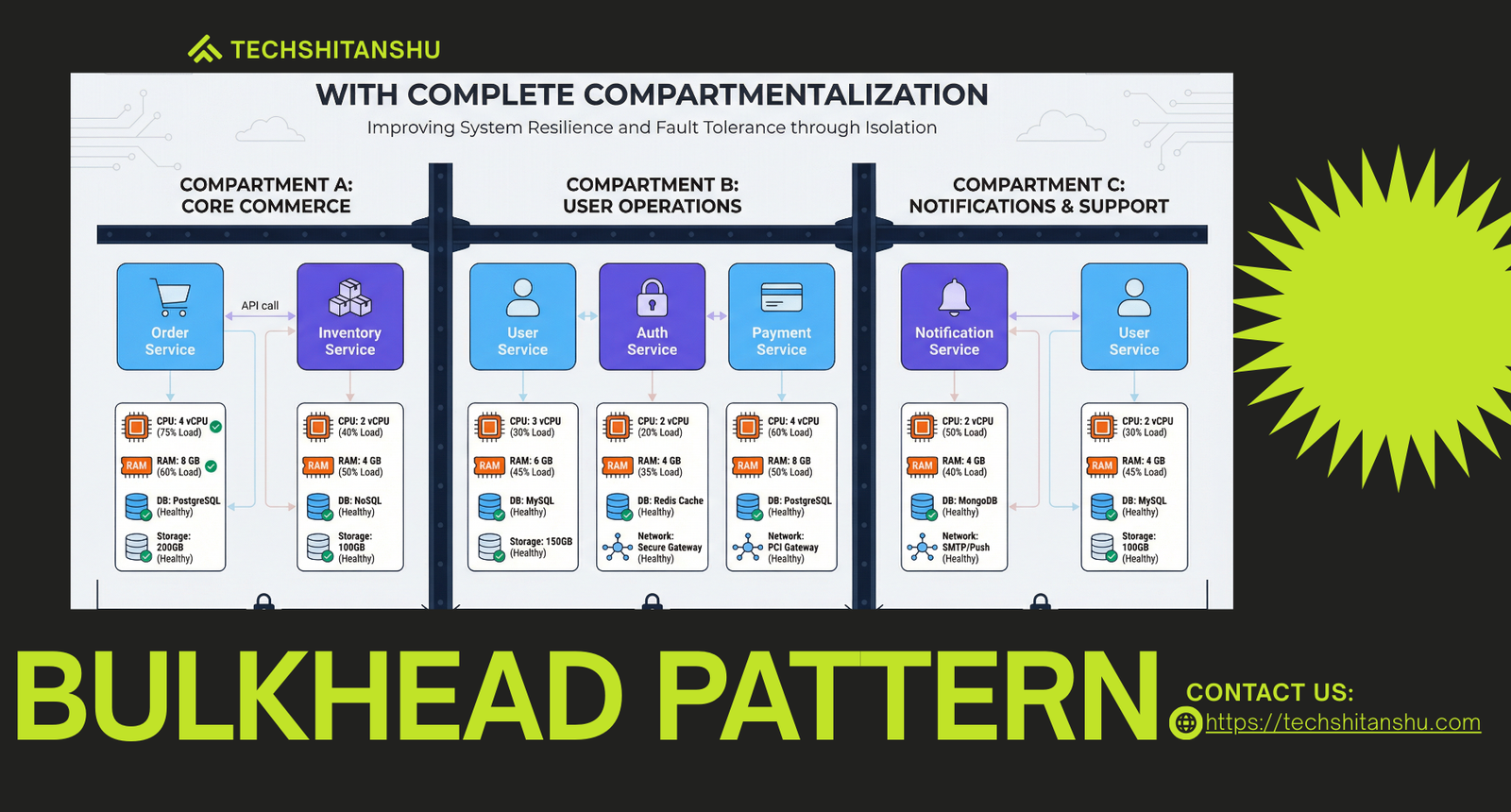
Bulkhead Pattern: Protect Microservices from Cascading Failures
Introduction: Why One Small Failure Can Take Down Everything
In distributed systems, failure is not an exception — it’s guaranteed.
What surprises teams is this:
One slow or failing service can bring down your entire platform.
A single overloaded dependency can:
Exhaust threads
Consume connections
Block requests
Trigger cascading failures
This is where the Bulkhead Pattern becomes critical.
What Is the Bulkhead Pattern?
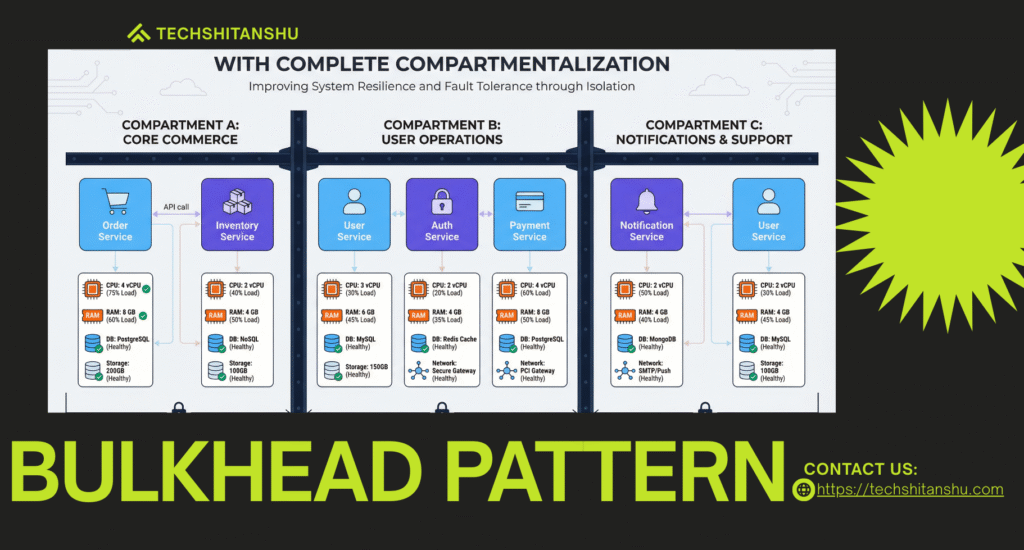
The Bulkhead Pattern isolates system resources so that failure in one component does not spread to others.
Just like bulkheads in a ship:
One compartment floods
The ship does not sink
In software:
One service fails
The system keeps running
Why It’s Called “Bulkhead”
In ships:
Bulkheads divide compartments
Damage is contained
In microservices:
Threads, connections, memory, or pools are isolated
Damage stays local
This makes the pattern a cornerstone of resilient system design.
Why Enterprises Care
The Bulkhead Pattern directly impacts:
High availability
SLA compliance
Cloud cost optimization
Production stability
That’s why it attracts premium ads related to:
Cloud platforms
Observability tools
Security & reliability
DevOps platforms
The Core Problem the Bulkhead Pattern Solves
Without isolation:
Service A slows down
Threads get blocked
Service B can’t respond
Entire system degrades
This is called a cascading failure.
The Bulkhead Pattern breaks this chain reaction.
Bulkhead Pattern Architecture (Conceptual)
					Client Requests
      |
-------------------------
|           |           |
Service A  Service B  Service C
(Thread Pool A) (Pool B) (Pool C)
Each service:
Has its own resources
Fails independently
Does not impact others
Types of Bulkheads in Software Architecture
1️⃣ Thread Pool Bulkhead
Each service or dependency has its own thread pool.
✔️ Most common
✔️ Easy to implement
2️⃣ Connection Pool Bulkhead
Separate database or HTTP connection pools.
✔️ Prevents resource starvation
✔️ Ideal for external dependencies
3️⃣ Process-Level Bulkhead
Run services in separate containers or VMs.
✔️ Strongest isolation
✔️ Common in Kubernetes
4️⃣ Rate-Limiting Bulkhead
Limit traffic per service or consumer.
✔️ Protects backend systems
✔️ Improves fairness
Real-World Example: Payment Service Isolation
Problem
Checkout service calls Payment API
Payment API slows down
Entire checkout freezes
Solution with Bulkhead
Dedicated thread pool for Payment API
Timeouts + fallback
Result:
✔️ Checkout stays responsive
✔️ Payment failures are isolated
Bulkhead Pattern vs Circuit Breaker
| Aspect | Bulkhead | Circuit Breaker |
|---|---|---|
| Purpose | Isolate resources | Stop failing calls |
| When It Acts | Always | After failures |
| Scope | Capacity protection | Fault detection |
| Best Used Together? | ✅ Yes | ✅ Yes |
👉 Best practice: Always combine Bulkhead + Circuit Breaker.
Benefits of the Bulkhead Pattern
✅ Prevents Cascading Failures
Failures stay local.
✅ Improves System Stability
Healthy services remain healthy.
✅ Predictable Performance
No surprise slowdowns.
✅ Better SLA Compliance
Critical paths are protected.
✅ Cloud-Native Friendly
Perfect fit for Kubernetes and microservices.
Common Use Cases
✔️ Microservices architectures
✔️ External API integrations
✔️ Payment gateways
✔️ Authentication services
✔️ High-traffic platforms
Challenges & Trade-Offs
⚠️ Resource Overhead
More pools = more configuration.
⚠️ Capacity Planning
Incorrect sizing can waste resources.
⚠️ Operational Complexity
Needs good monitoring.
But compared to outages?
👉 It’s a small price to pay.
Best Practices for Implementing Bulkheads
✔️ Identify critical dependencies
✔️ Start with thread isolation
✔️ Combine with timeouts
✔️ Add circuit breakers
✔️ Monitor pool saturation
✔️ Tune gradually in production
Bulkhead Pattern in Modern Cloud Systems
Works extremely well with:
Kubernetes (Pod isolation)
API Gateway Pattern
Service Mesh (Istio, Linkerd)
Resilience4j / Hystrix-like libraries
Observability tools (Prometheus, Grafana)
When NOT to Use Bulkheads
Very small monolithic apps
Low-traffic internal tools
Systems with no concurrency
FAQs
❓ Is the Bulkhead Pattern mandatory for microservices?
Not mandatory, but highly recommended for production systems.
❓ Can Bulkheads increase latency?
Slightly, if misconfigured — but they prevent much worse failures.
❓ Is Kubernetes already a bulkhead?
Yes, at the infrastructure level — but application-level bulkheads are still needed.
❓ Do I still need Bulkheads with autoscaling?
Yes. Autoscaling reacts after damage; bulkheads prevent it.
❓ Can Bulkhead Pattern be used in monoliths?
Yes, via thread pools and modules.
Final Thoughts
The Bulkhead Pattern doesn’t make your system faster —
it makes your system survivable.
In distributed systems:
Stability beats speed every time.
If you care about:
Uptime
Reliability
Enterprise readiness
Bulkheads are not optional.
“Part of our Microservices Design Patterns Series.”

Leave a Reply