Saga Pattern – The Complete Guide to Data Consistency Without Distributed Transactions (2026)
Introduction: Why Distributed Transactions Fail in Microservices
In monolithic systems, a database transaction is simple:
✔ Begin
✔ Commit
✔ Rollback
But microservices break this simplicity.
Each service:
Owns its own database
Runs independently
Cannot share ACID transactions
So what happens when:
Payment succeeds
Inventory fails
Shipping already started?
Welcome to the world of distributed transactions — and chaos if handled incorrectly.
The Saga Pattern exists to solve this exact problem.
What Is the Saga Pattern?
The Saga Pattern manages a long-running business transaction as a sequence of local transactions across multiple microservices.
Each step:
Updates its own database
Publishes an event or calls the next service
Has a compensating action if something fails
In Simple Terms
Instead of one big transaction, you run many small ones — and undo them if needed.
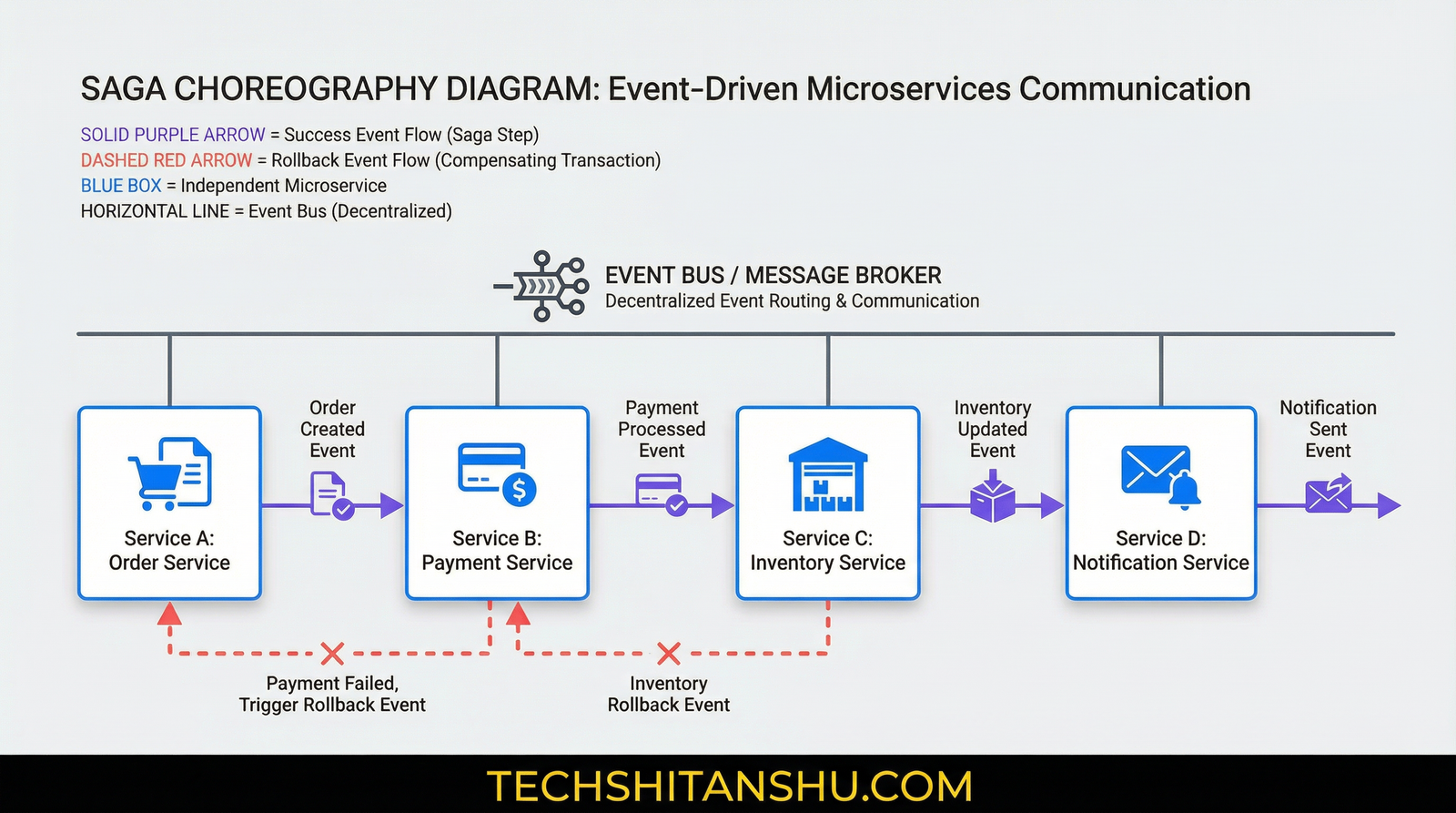
of services without dragging in those clunky distributed transactions. No more wrestling with two-phase commits gone wrong—pure bliss!
But hey, it’s not all rainbows. Downsides include no auto-rollback magic. You gotta play hero and code “compensating transactions” to undo stuff manually, instead of kicking back while ACID does the heavy lifting. Oh, and kiss isolation goodbye (that’s the “I” in ACID). Multiple sagas crashing the party at once? Cue data chaos! You’ll need clever tricks (aka countermeasures) to fake isolation, plus a PhD in analysis to pick the right ones.
Plus, you’ve got these headaches to wrangle:
Services gotta atomically update the DB and fire off a message/event without distributed transactions spanning DB and broker. Pick from patterns below to make it reliable—no half-measures!
Clients kick off sagas with a sync request (like HTTP POST /orders), but sagas are async wild rides. How do they know if it worked? Options with trade-offs:
Service holds its breath till saga ends, then replies with “OrderApproved” or “OrderRejected.” (Spoiler: timeouts suck.)
Service spits back an orderID quick, client polls like a needy ex: GET /orders/{orderID} until it spills the beans.
Same quick orderID reply, then saga pings the client later via websocket, webhook, or whatever—event-driven high-five!
Why the Saga Pattern Is Essential
Without Saga:
❌ Partial data updates
❌ Inconsistent systems
❌ Manual recovery nightmares
With Saga:
✅ Eventual consistency
✅ Failure isolation
✅ Clear rollback strategy
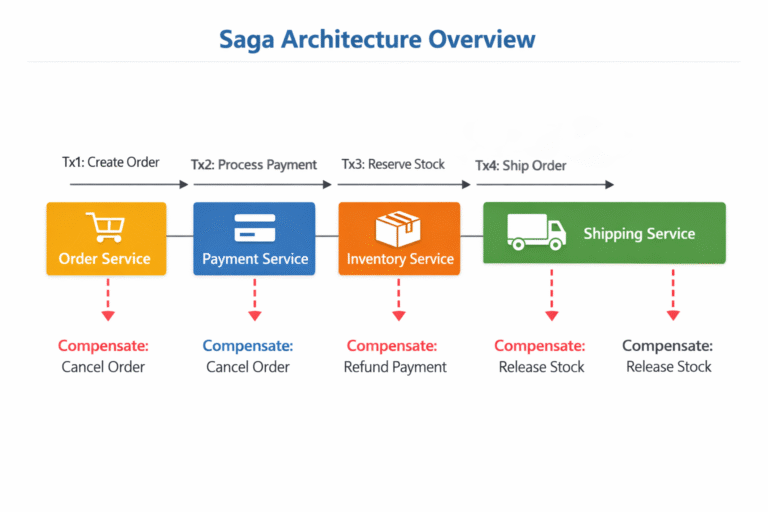
Core Concepts of Saga
1️⃣ Local Transactions
Each service commits its own database transaction independently.
2️⃣ Compensating Transactions
Undo logic that reverses a completed step if the saga fails later.
3️⃣ Event-Driven Flow
Services communicate via events or commands.
Types of Saga Pattern
There are two major Saga implementations, and choosing the right one is critical.
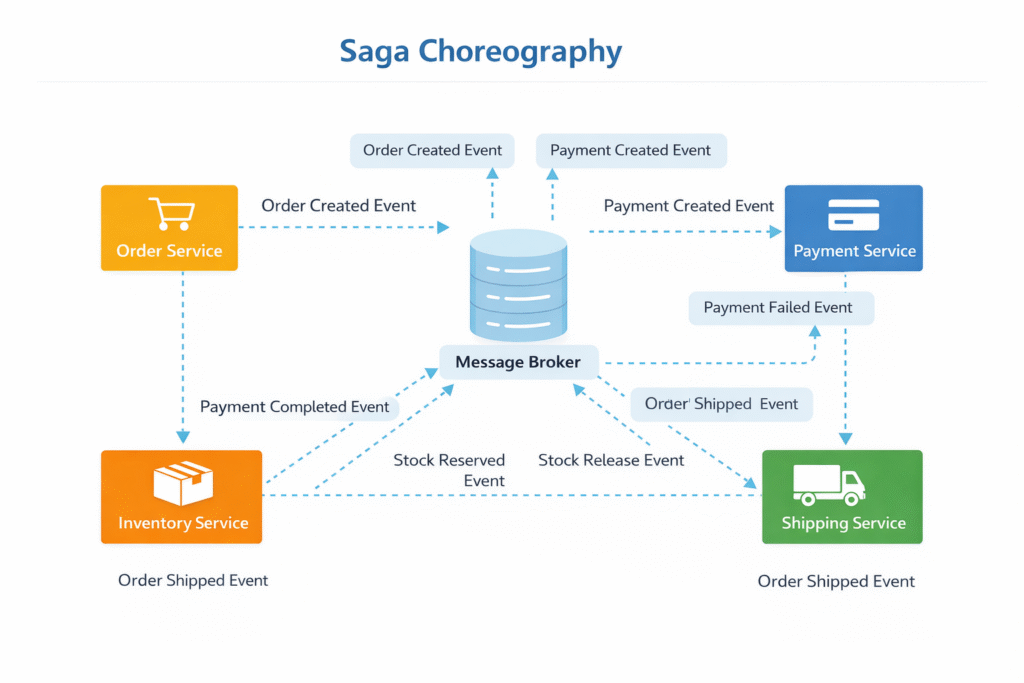
1️⃣ Choreography-Based Saga
In choreography:
No central controller
Services listen to events
Each service decides what to do next
Flow Example
Order Service emits
OrderCreatedPayment Service listens and processes payment
Inventory Service listens and reserves stock
Pros
Fully decentralized
Loose coupling
Highly scalable
Cons
Harder to debug
Event flow complexity
Risk of event chaos
2️⃣ Orchestration-Based Saga
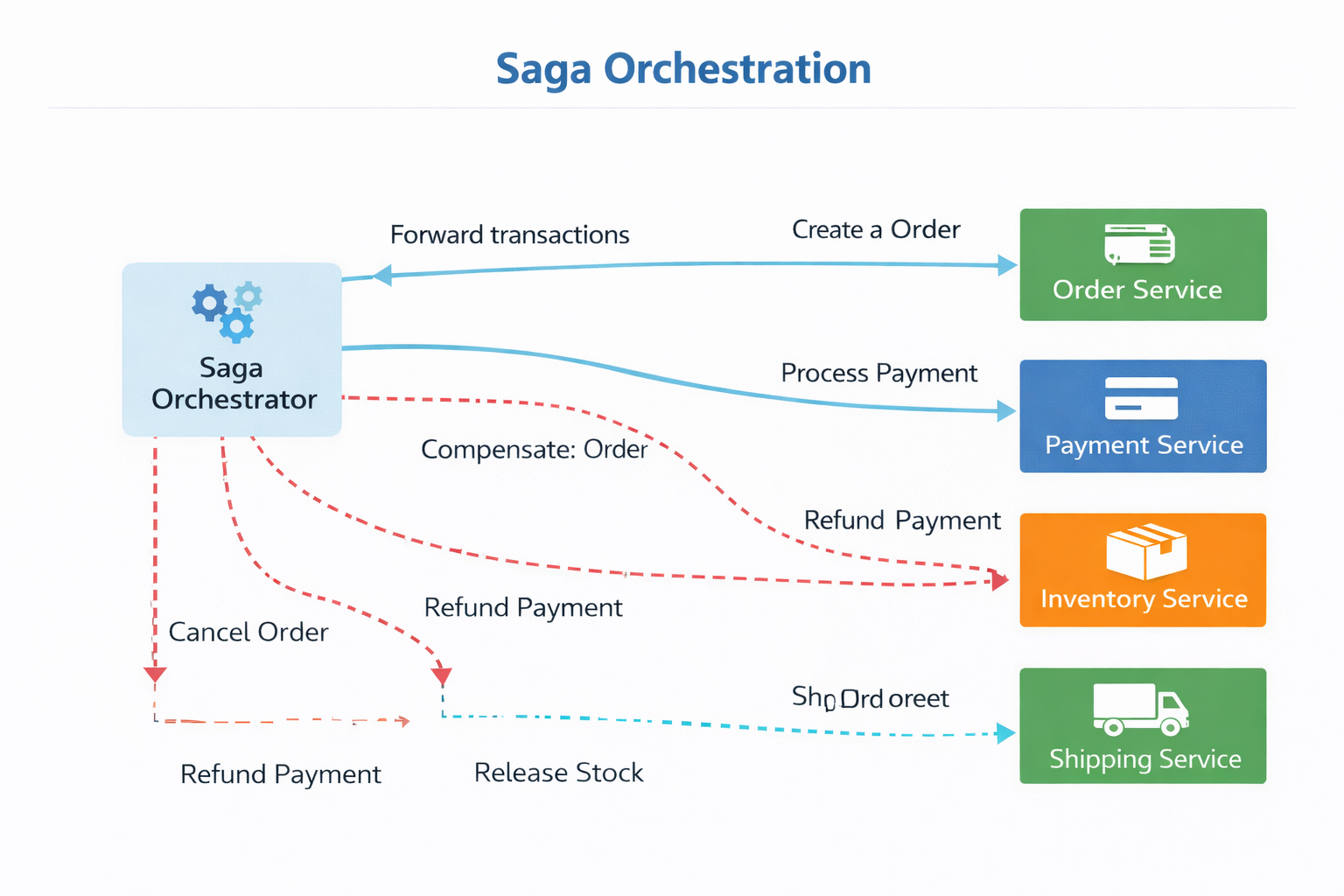
In orchestration:
A Saga Orchestrator controls the flow
Sends commands to services
Handles success/failure paths
Flow Example
Orchestrator calls Payment
Calls Inventory
Calls Shipping
Triggers compensations if needed
Pros
Clear control flow
Easier monitoring
Better error handling
Cons
Centralized logic
Orchestrator complexity
Saga Pattern vs Two-Phase Commit (2PC)
| Feature | Saga | 2PC |
|---|---|---|
| Scalability | High | Low |
| Performance | Better | Slower |
| Coupling | Loose | Tight |
| Cloud friendly | Yes | No |
Saga wins for microservices.
Real-World Use Case: E-Commerce Order
Forward Flow
✔ Create Order
✔ Process Payment
✔ Reserve Inventory
✔ Arrange Shipping
Failure Scenario
❌ Inventory fails →
↩ Refund Payment
↩ Cancel Order
This is Saga in action.
Common Mistakes to Avoid
❌ No compensating transactions
❌ Overusing choreography for complex flows
❌ Ignoring idempotency
❌ Poor event versioning
Best Practices (Production-Ready)
✔ Prefer orchestration for complex business logic
✔ Design idempotent services
✔ Use timeouts + retries + circuit breakers
✔ Log saga state changes
✔ Monitor saga execution
Saga + Other Patterns (Power Combo)
Saga + Circuit Breaker → safer rollbacks
Saga + API Gateway → clean entry point
Saga + Event Sourcing → audit trails
Tools & Technologies for Saga
Messaging
Kafka
RabbitMQ
AWS SNS/SQS
Workflow Engines
Camunda
Temporal
Zeebe
FAQs
❓ When should I use the Saga Pattern?
When a business transaction spans multiple microservices and needs consistency.
❓ Is Saga eventually consistent?
Yes — and that’s by design.
❓ Which is better: choreography or orchestration?
Choreography for simple flows, orchestration for complex business logic.
❓ Can Saga fail?
Yes — but failures are controlled and recoverable.
❓ Is Saga suitable for banking systems?
Yes, with orchestration and strong compensation logic.
Link to:
Service Discovery Pattern
API Gateway Pattern
Circuit Breaker Pattern
Microservices Design Patterns (Pillar Article)
Anchor text example:
“Part of our Microservices Design Patterns Series.”

Leave a Reply